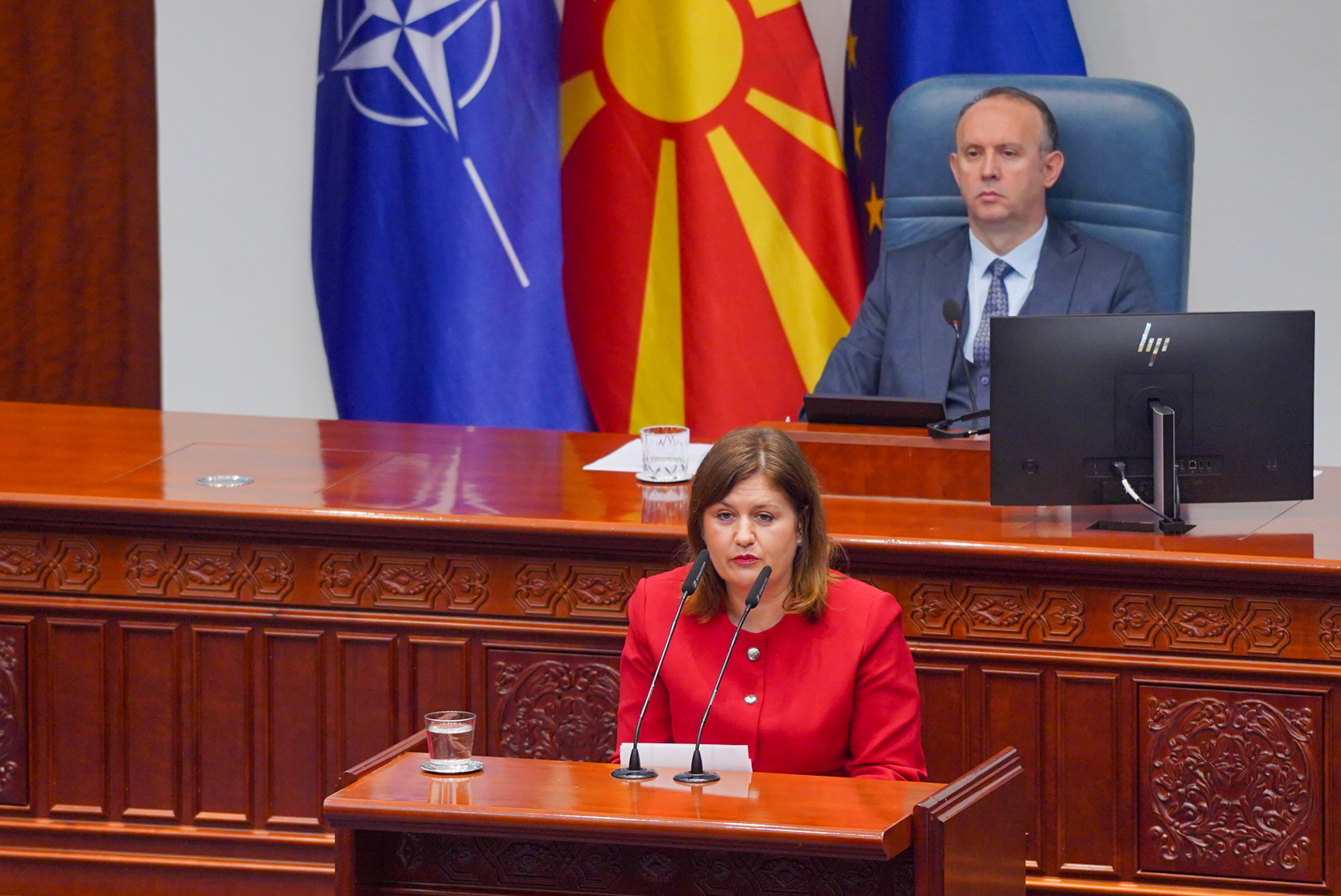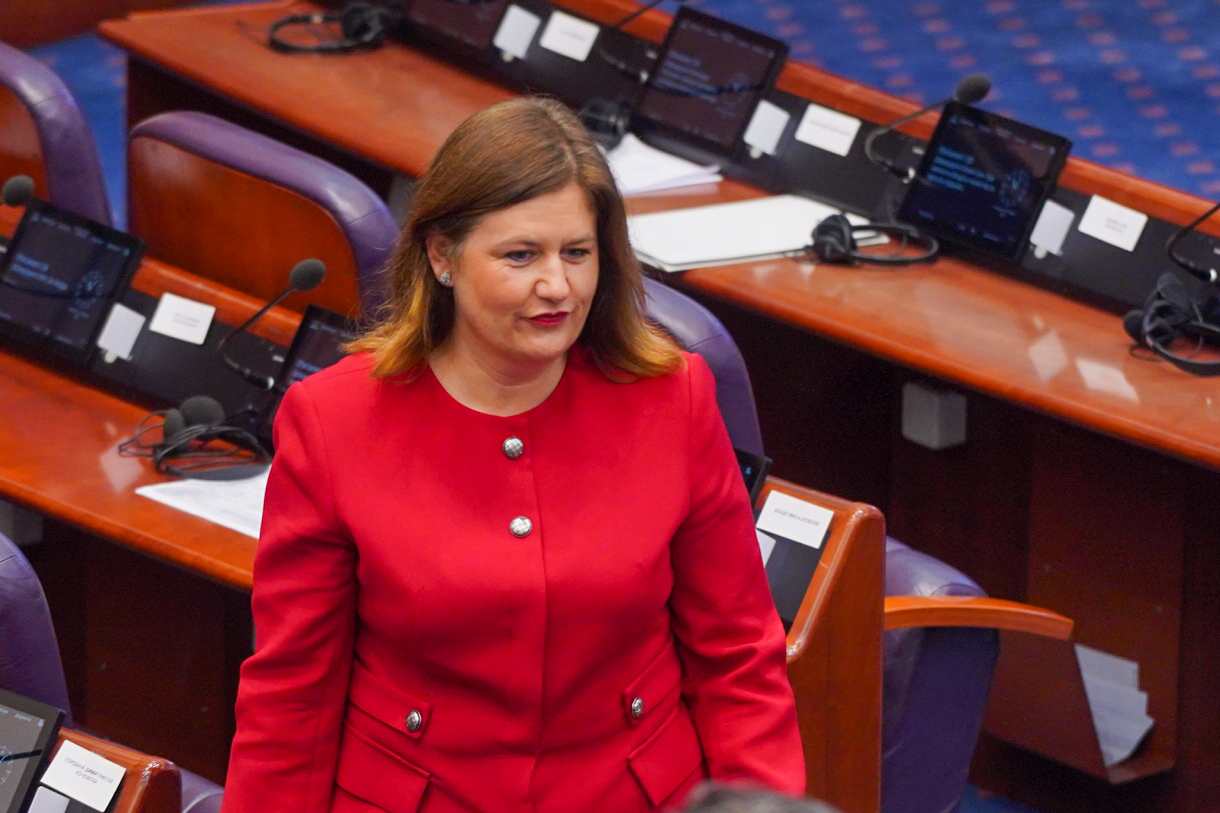
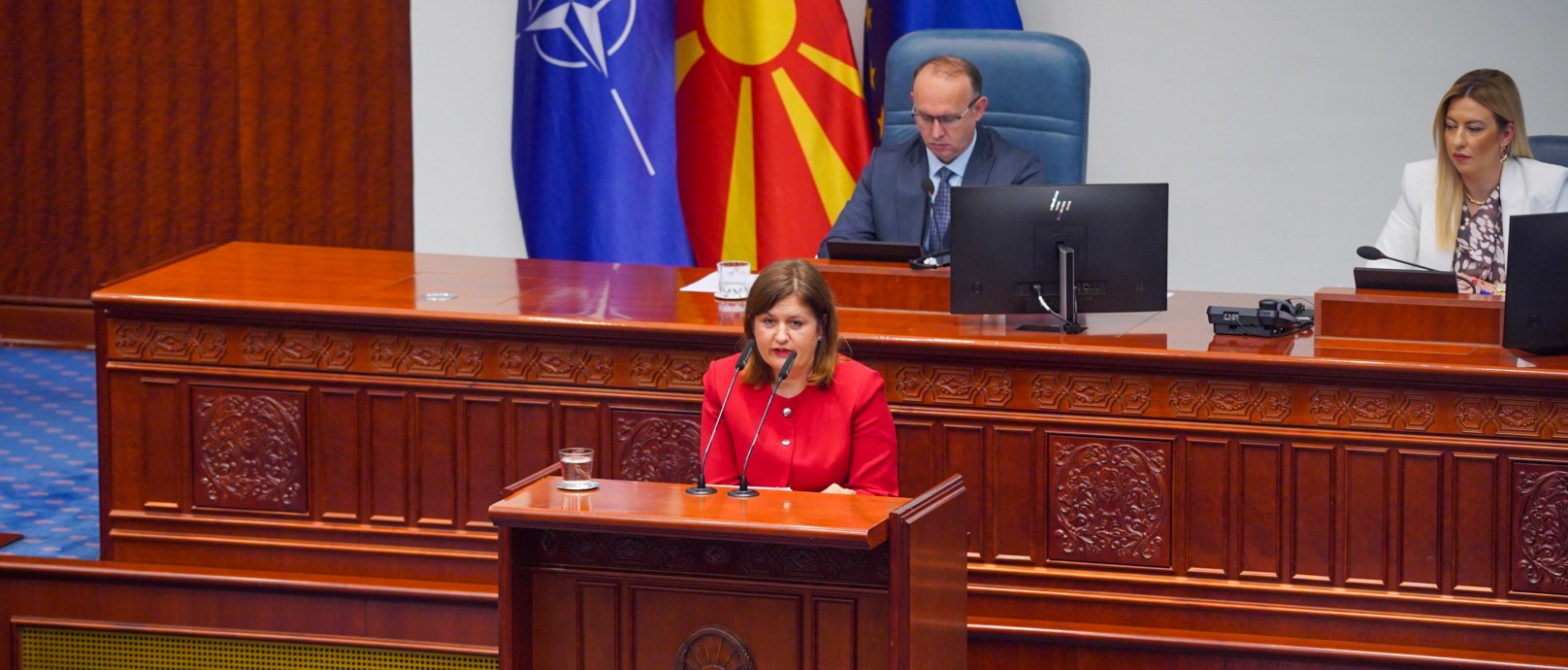
Minister of energy, mining and mineral Resources Sanja Bozhinovska, in her address to the Assembly during the interpellation concerning her work, presented the Ministry’s results and responded to allegations regarding the management of the energy sector, electricity prices, and the use of mineral resources. She called on MPs to assess responsibility based on legal competences, documents, and specific decisions, and not to support the interpellation. Bozhinovska stressed that parliamentary oversight is an integral part of democratic governance and that the interpellation is an opportunity to provide citizens with concrete answers regarding the policies pursued and the results achieved.
“I respect your right to call for me to be held accountable. I will also ask you to accept responsibility for the accuracy of the claims on which you are basing your request,” the Minister said.
In response to the allegations, she drew a clear distinction between the responsibilities of the Ministry, the Government, ESM, MEPSO, the Energy, Water Services and Municipal Waste Management Services Regulatory Commission, and other institutions. She pointed out that she is responsible for energy policy, planning, security of supply, renewable energy sources, energy efficiency, mining, and mineral resources, but that the Ministry does not conduct ESM’s operational procurement, commercial agreements, or electricity generation. Regarding tariff decisions, she emphasized the independent role of the Energy Regulatory Commission and explained that the Ministry cannot instruct it on what tariff to adopt.
“Responsibility is not established by conflating the roles of institutions. It is established by law, by a document, and by a specific decision,” Bozhinovska stressed.
She paid particular attention to the procedure for selecting a universal supplier, noting that the decision to initiate the procedure was adopted on 17 October 2023, the commission was established on 7 November 2023, while the auction and the Government’s conclusions on the selection date from April 2024. Against this timeline, the Ministry of energy was established in June 2024.
“How can you attribute to me the organisation of a procedure that began and concluded before the Ministry even existed?” Bozhinovska asked, adding that she had neither headed the commission nor been Minister when it made its decisions.
Regarding the allegations that ESM was to be sold, the Minister stressed that the Ministry had not adopted any decision to sell the company and called for claims that it was being sold off to be substantiated by a specific legal act and procedure.
Speaking about electricity prices, Bozhinovska explained the policy of protecting households from price shocks. According to her address, the price at which ESM supplies electricity for universal supply is part of the public policy aimed at keeping electricity affordable for citizens. She distinguished between the cost of generation, the selling price, and the regulated tariff, emphasizing that these are three distinct concepts that should not be conflated. Citing the sectoral data submitted, she stated that ESM’s electricity generation costs had fallen from more than 130 euros to around 100 euros per megawatt-hour.
Among the key achievements, the Minister highlighted the new Law on Energy. According to the figures she presented, 64 of the 74 amendments submitted were accepted during the parliamentary procedure, following public consultations and alignment with the Energy Community. She noted that the new framework regulates energy storage, energy communities, and greater consumer participation, while providing companies with clearer rules for investment.
Bozhinovska also referred to the National Energy and Climate Plan 2025–2030, which contains 61 measures, as well as the annual planning of new energy facilities. For 2026, she cited a planned capacity of approximately 4,417 megawatts and 96 storage systems, while making it clear that implementation would depend on subsequent grid-connection requirements, permits, and project execution.
Regarding infrastructure, she highlighted MEPSO’s final certification in 2026, the commissioning of the new transformer at Bitola 2, and the resolution of a long-standing issue concerning the registration of facilities owned by the company. She also pointed to the continuation of work on the interconnector with Albania and the Ohrid substation.
She presented the development of gas infrastructure as an opportunity to diversify supply routes and reduce dependence on a single connection. She highlighted the interconnector with Greece, the agreement on the Macedonian section of the connection with Serbia, accession to the Vertical Gas Corridor framework, and ongoing work to explore the possibility of a connection with Kosovo. Regarding the interconnector with Greece, she noted that following a new tender procedure, the lowest bid had fallen from 70.3 million euros to 59.95 million euros.
“These are the country’s energy highways,” Bozhinovska said, emphasising their importance for industry, competition in energy supply, and future transit services.
As part of the social dimension of energy policy, the Minister outlined measures for households struggling to cover their energy costs. She stated that 3,750 vouchers worth 28,000 denars each had been issued under the 2025 programme, amounting to a total of 105 million denars, while 480 electronic vouchers had been issued under the 2026 programme. According to her address, this year’s measure targets households with people with disabilities and children with disabilities.
Bozhinovska also highlighted the energy renovation plan for 14 public buildings covering approximately 103,000 square metres and housing 33 institutions. Regarding the just transition in Bitola and Kichevo, she referred to 676 people who had completed training programmes organised with ESM and the EBRD, as well as a platform featuring 84 projects with an estimated total value of approximately 1.79 billion euros.
In the mining sector, the Minister presented higher concession fees and increased revenue collection as results of placing greater value on the country’s natural resources. According to the figures presented, the concession fee for metallic mineral raw materials had increased from 2% to 4%, for marble from 1% to 5%, and for the relevant category of non-metallic mineral resources from 11 denars to 30 denars per tonne. Total revenue collected, she stated, had risen from approximately 561.5 million denars in 2024 to around 1.222 billion denars in 2025.
She stressed that increased revenue collection does not remove the obligation to act on every outstanding debt. In this regard, she pointed to the termination of 53 concession agreements and the strengthening of inspection capacity through the recruitment of three additional inspectors in 2026.
“This is a message that a concession is not an unconditional right and that every obligation must be respected,” Bozhinovska stressed.
The Minister linked support for investment with environmental protection and the financial responsibility of concession holders. She noted that the new legislative framework proposes 100% financial coverage of the estimated costs under the relevant mining waste management plan and associated obligations.
“We do not want to put the environment at risk, nor do we want to cause harm to the population or the state,” she said. She added that knowledge of the geological potential does not in itself constitute authorization to open a mine.
In her address, Bozhinovska highlighted the Ministry’s 100% score in the 2026 Active Transparency Index. She reiterated that the Ministry remains open to MPs and that criticism should be part of democratic oversight, together with responsibility for the accuracy of the claims made.
“Political disagreement cannot be declared unlawful. A different vision for the energy sector cannot be declared a violation of the Constitution. And an accusation does not become a fact simply because it has been written into an interpellation,” Bozhinovska stressed.
The Minister concluded her address by stating that she would continue to make decisions within the scope of her responsibilities and remain accountable for them to citizens and the Assembly.
“Public office is temporary. Responsibility to the state remains. And the truth is not established by the number of written criticisms, but by the strength of the evidence,” Bozhinovska concluded.
With regards,
Ministry of energy, mining and mineral resources